

Where Cows Go, Soil Fertility Follows: Reworking Winter Feeding in Okmulgee County
As temperatures drop across Okmulgee County, our warm-season pastures—primarily bermudagrass, native tallgrasses, and introduced bluestems—are shutting down for the season. For decades, the standard winter routine for many local operations has been feeding hay at a single, convenient permanent feeding pad or sacrificial paddock near the barn.
While sacrificing a couple of acres to “mud-bogging” conditions might seem like a fair trade to protect the rest of the farm, research shows it locks up hundreds of dollars in fertility where your pastures need it least.
The Hidden Cost of the "Sacrifice Area"
When cattle gather in the same spot all winter, they deposit the vast majority of their dung and urine in an extremely small footprint.
Recent research from a multi-state bale grazing initiative led by the University of Kentucky and USDA soil ecologist Dr. Alan Franzluebbers highlights just how stark this nutrient imbalance is:
- Massive Nutrient Traps: In grid soil testing across long-term feeding areas, researchers found that soil nitrogen was 10% to 40% higher in the immediate impact zone (within ~87 yards of the feeding site) compared to the rest of the pasture.
- Locked-Up Phosphorus & Potassium: Soil levels of phosphorus (P) and potassium (K) were even more extreme, heavily concentrated in just 7% of the total pasture area.
Instead of letting that fertility accumulate in mud holes, moving your feeding location—either through unrolling hay or bale grazing—redistributes those exact inputs across your entire acreage.
1. Unrolling Hay: Daily Targeted Distribution
Unrolling round bales using a tractor attachment or bale bed spreads hay out into a thin strip, allowing cattle equal access along a extended line.
- Nutrient Value: A single round bale of bermudagrass hay contains nitrogen, phosphorus, and potassium roughly equivalent to 100 lbs of 17-17-17 commercial fertilizer. Unrolling over thin hilltops, eroded slopes, or low-fertility native ground distributes that fertilizer naturally.
- Calving Sanitation: Moving the unrolling site daily prevents high-pathogen mud buildup, drastically reducing calf scours and navel ill during winter calving.
- Waste Management Rule: Oklahoma State University Extension research shows that unrolling only one day’s worth of hay keeps waste low (10–15%). Unrolling 3 or more days at once spikes waste to 25–50% through trampling.
2. Bale Grazing: Labor Reduction & Mud Management
Bale grazing involves placing bales in a grid layout across targeted pastures during dry late-autumn conditions, using temporary electric polywire to allocate bales every 2 to 5 days.
- Keeping Heavy Rigs Off Wet Ground: Okmulgee County freeze-thaw cycles turn pastures into deep mud in January and February. Pre-placing bales in November avoids running heavy tractors over soft pasture sod during peak winter, preventing soil compaction and saving fuel.
- Regenerative Soil Building: Concentrating hay residue, urine, and manure across poor spots improves organic matter, water retention, and microbial activity ahead of spring green-up.
- Allocation Rule: Polywire allocation is essential. Unrestricted access to pre-placed bales results in cattle using valuable hay as bedding, drastically increasing waste.
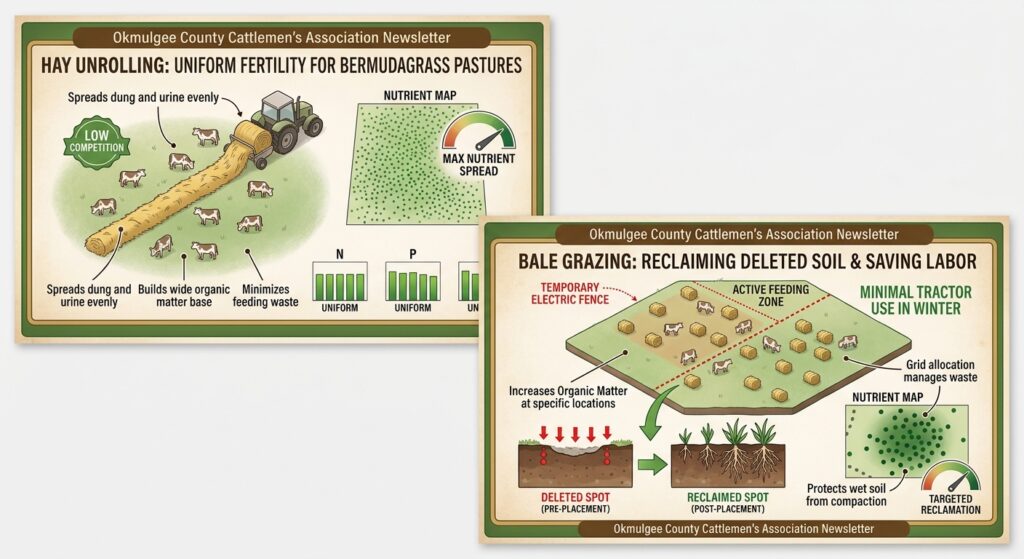
Comparison: Choosing the Strategy for Your Ranch
Feature | Unrolling Hay | Bale Grazing |
Primary Advantage | Precision feeding & minimum hay waste | Drastically reduced tractor usage in winter mud |
Labor Profile | Daily tractor or bale-bed routine | Upfront fall labor; quick daily/periodic wire moves |
Hay Waste Level | 10–15% (when unrolling 1 day’s feed) | 15–25% (depending on polywire move frequency) |
Best Local Soil Application | Uniform fertility across wide bermudagrass fields | Spot-treating thin ridges, eroded slopes, or poor soils |
Site & Research References
- Hay & Forage Grower / University of Kentucky Beef Extension:
- Where Cows Go, So Goes Soil Fertility (Reporting on multi-state research led by Dr. Greg Halich & Dr. Alan Franzluebbers). Details grid soil sampling data showing 10–40% higher nitrogen and extreme P/K concentrations in permanent feeding zones. Hay & Forage Article Source
- Oklahoma State University Extension – Beef Cattle Management:
- Producers Should Rotate Hay Feeding Locations for Cattle (Dr. Paul Beck, OSU Beef Extension Specialist). Analyzes the 100 lb fertilizer equivalent per round bale and disease reduction benefits. OSU Extension Article
- Oklahoma State University Extension – Winter Hay Waste:
- Take Steps to Maximize Available Hay in Cattle Operations (Dr. David Lalman & Dr. Paul Beck). Outlines hay waste percentages based on unrolling schedules. OSU Extension News
- Noble Research Institute:
- How To Use Bale Grazing and Other Hay-Feeding Strategies To Build Soil Health. Practical guidelines on grid layout, polywire strip-grazing, and soil organic matter building in Southern Plains pastures. Noble Research Guidelines
- Okmulgee County OSU Extension Office:
- For local forage testing, soil sampling kits, and stocking rate recommendations, contact the Okmulgee County Extension Educator. OSU Forage & Pasture Program Page