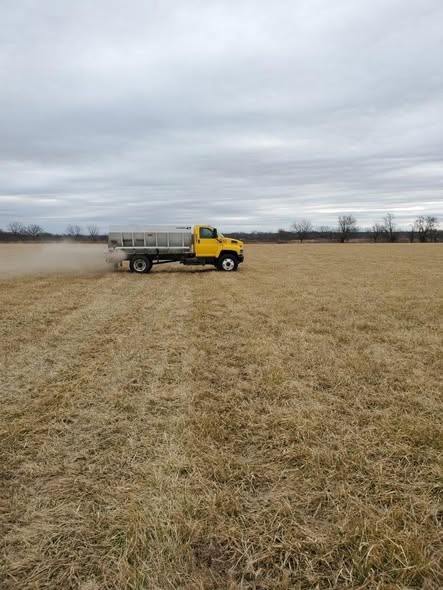

For Oklahoma cattle producers and hay farmers, the key to a lush, productive pasture isn’t just fertilizer—it’s lime. Many soils across the state, especially in the eastern regions, are naturally acidic. If you haven’t checked your soil pH recently, you could be losing money and sacrificing forage quality without even knowing it.
Applying agricultural lime is the most cost-effective long-term solution for correcting soil acidity and creating the perfect foundation for healthy grass and soil life.
The 6 Major Benefits of Liming Your Pastures
Lime is much more than a simple amendment; it’s a soil conditioner that impacts nearly every part of your forage system:
1. Maximizes Fertilizer Efficiency (The “Unlocking” Effect)
In acidic soil, essential nutrients like Phosphorus (P) and Potassium (K) get “tied up.” This means they chemically bond with other elements and become unavailable to your grass, no matter how much fertilizer you apply.
- Lime fixes this: By neutralizing acidity, lime releases these locked-up nutrients, allowing the grass to absorb them efficiently. This means your fertilizer dollars go directly into growing grass, not into the soil to be wasted.
2. Grows Deeper, Stronger Roots
High soil acidity increases the presence of elements like aluminum, which are toxic to plant roots. They cause stunting, forcing roots to stay near the surface.
- Lime fixes this: Neutralizing the aluminum allows for deep, healthy root growth. A deeper root system improves the grass’s ability to forage for nutrients and, critically, makes your pasture far more resilient to drought and heat stress.
3. Enhances Soil Health and Structure
Lime is a fundamental part of good soil stewardship, improving the physical, chemical, and biological environment.
- Better Drainage: The calcium in lime helps soil particles “flocculate” (clump together). This improves the structure of heavy clay soils, leading to better water infiltration and aeration.
- Active Soil Life: Beneficial soil microbes, fungi, and earthworms—essential for breaking down organic matter and cycling nutrients—thrive in a near-neutral pH. Lime creates the optimal habitat for this crucial soil biology.
4. Boosts Legume Performance
If you rely on legumes like clover for natural protein and forage quality, they are highly sensitive to acidity.
- Lime fixes this: It provides the environment clovers need to flourish. More importantly, it activates the bacteria associated with their roots to perform Nitrogen fixation, meaning the clovers pull N from the air and provide a constant source of free fertilizer for all the surrounding grasses.
5. Increases Forage Yield and Quality
All the above benefits—better nutrient uptake, stronger roots, and enhanced soil life—combine to create more robust, vigorous forage.
- The result is a higher overall yield, whether you are grazing cattle or cutting hay. Additionally, lime has been shown to improve the palatability and mineral content of the forage for your livestock.
6. Natural Weed & Disease Control
Many common pasture weeds and mosses are acid-loving species.
- Lime fixes this: By raising the pH to a neutral range (7.0), you make the environment less hospitable to these invasive species, allowing your desirable grasses to grow dense and crowd them out.
When and How to Apply Lime in Oklahoma
The benefits of liming are clear, but it’s a long-term strategy, not a quick fix.
- Start with a Soil Test: This is non-negotiable. A professional soil test will tell you your current pH and precisely how many pounds of lime (the lime requirement) you need to apply to reach your target pH of 7.0.
- Timing is Key: Lime reacts slowly. It needs time, moisture, and freeze-thaw cycles to dissolve and work its way into the soil profile.
- The Best Time: Apply agricultural lime in the fall or early winter. This gives the material several months to begin neutralizing the soil before the spring growing season.
- If you plan to establish a new pasture, lime must be applied and incorporated before planting to give the young seedlings the best chance to survive.
Lime application is one of the most fundamental and profitable investments a pasture manager can make. Take the first step this fall: test your soil and unlock the full potential of your Oklahoma pasture.
By: Clint Scism, SCR Construction
918-261-4578