

By:
Mark Z. Johnson, OSU Extension Beef Cattle Breeding Specialist
Dana Zook, NW OK Area Livestock Specialist
Emily Efird, OSU Extension Okmulgee County Agriculture Educator
Managing beef herds around significant fly populations is a reality that many Oklahoma producers face every summer. The Oklahoma beef cattle industry loses millions of dollars every year due to damage/losses from external parasites. It is imperative that horn and stable flies are controlled before producers begin seeing losses through irritation, annoyance, and blood loss on their animals. With an abundance of early spring warmth, recent rainfall, and high humidity levels, most of Oklahoma now serves as an ideal breeding ground for these annoying pests that can rob you of profit potential on your beef operations.
Horn flies are the most significant parasites of cattle, causing an estimated $1.8 billion impact on the cattle industry each year. These flies are usually found feeding from the back of the cow, down the side, and even onto the belly of the animal. Although small in size, it is the sheer number of horn flies on a per-animal basis that causes stress to cattle. Since each horn fly will feed on an animal 25 times per day, it is easy to understand how impactful these little pests can be. Specifically in cow/calf operations, horn flies will negatively impact weaning weights due to stress-induced decreases in milk production from the cow. This problem is further compounded by annoyance, blood loss, and stress incurred by flies that are feeding on the calf.
Stable flies are most commonly a problem on cattle operations between the months of March through May. Stable fly populations will typically decrease once temperatures are consistently above 90 degrees (June – August). In the average year, there are two distinct peaks of stable fly populations in Oklahoma: the first in early April, and the second in late September. These pests can be seen feeding on the front legs of cattle and occasionally on the belly. Their bite is very painful, which causes significant behavioral responses such as leg stomping, bunching, and standing in water for long periods of time (to avoid bites). One of the most preferred breeding sites of stable flies are old and damp hay feeding areas that retain moisture for several months. A typical hay ring/round bale feeding area can provide sufficient habitat for approximately 60,000 stable flies per week!
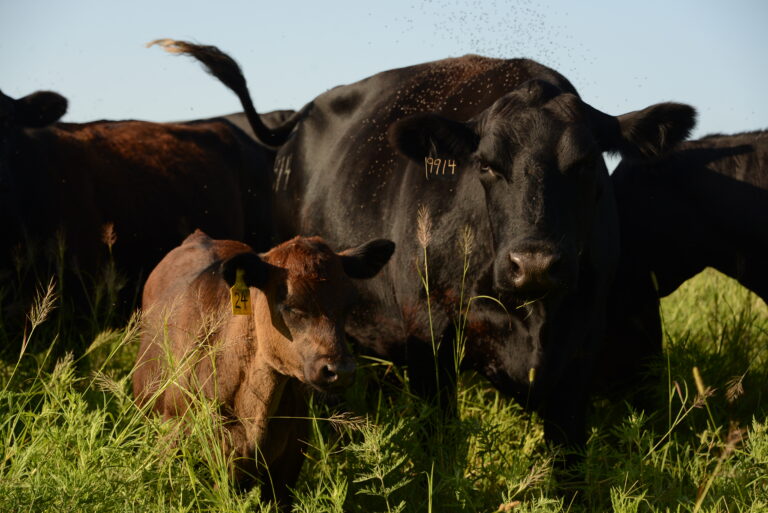
The quickest method to provide relief to cows from fly-biting activity is utilizing an insecticide applied directly to the animal. For stable flies, treatment thresholds are only ten flies per animal (when observing just the front legs). Therefore, it is imperative to control these pests early and before potential decreases in production may occur. For stable flies, it is best to determine their breeding habitats (damp hay feeding areas) and clean the area up so that the moisture can dry out. For an insecticide application, the best method is to spray the legs, brisket, and belly areas with a product that is labeled for “on-animal use”. An issue with on-animal applications is that cattle may get their legs wet and wash off any insecticide that was applied. Applying the insecticide with a diesel oil as the carrier can aid in the treatment persisting longer than applications using water. For this method, producers need to utilize a product that can be mixed with diesel and use a sprayer with pumps designed for diesel.
One of the most popular options for horn fly control are “pour-on” products. If using a pyrethoid pour-on, it is important to verify that the product is synergized with piperonyl butoxide (PBO). This synergist inhibits enzymes that insecticide resistant flies can develop to detoxify the insecticidal compound. Insecticide impregnated ear tags are a viable option for longer periods of horn fly control, but operators will need to rotate the type of product used each year to limit opportunities for insecticide resistance. Rotating products is not based on trade names, but rather on the chemical classification that the product belongs in. For instance, a product can fall within three broad chemical classes based on its mode of action (the way the product kills the fly based on target site). Products that are labeled for on-animal applications are either pyrethroids, organophosphates, or macrocyclic lactones. Please contact your veterinarian or Okmulgee County Extension office for help in identifying which chemical class a product belongs to based on its active ingredient.
There are a few other options available to producers looking to offer fly relief in their herds. Insect growth regulators (IGR) that are fed through minerals can be a very good option when combined with other applications, such as ear tags, pour-ons, or sprays. When selecting a mineral option, however, producers need to monitor consumption levels to verify that the herd is averaging 4 ounces/head/day for proper fly prevention. When implementing an IGR and ear tag combination protocol, it is recommended to feed IGRs in the spring, followed by ear tags in late May/early June. Most ear tags are only effective for 3 to 4 months, so a delayed ear tag application guarantees control during the peak horn fly season (July/August). Also, feeding IGRs in the spring can decrease fly populations in the summer (since the chemical is already present in manure before the flies begin laying eggs). Self-application devices, such as oilers, can be effective if implemented within a “force-use” system. A typical force-use system includes setting the device up so that cattle must go under the oiler to get to water or feed areas.
As flies have become more resistant to insecticide methods, many producers have inquired about the use of garlic as a fly control option (normally included in a loose or block mineral product). Producers have had mixed opinions regarding its effectiveness, reporting inconsistent results from one year to the next. Surprisingly, there is only one scientific study that has been conducted on the effectiveness of garlic as a fly control option. The study was conducted in Alberta, Canada in 2021 and reports inconsistent findings regarding garlic’s effectiveness to prevent/control fly populations. There are a few things to consider before trying garlic as a fly control in your herd. First, understand that any product fed through mineral is impacted by consumption; if cattle don’t eat the mineral, then they will not be consuming the product. Secondly, garlic is not always considered a registered feed product in every state, although several garlic products are within Oklahoma’s registrations. You can check out this list at kellysolutions.com/ok/searchbyproductname.asp. Finally, here at OSU Extension, we stand by scientific, data-proven research. Until more research is done on garlic, we cannot include it as a recommendation for fly control in beef cattle herds. Until then, please remember to rotate your fly control chemicals and contact your veterinarian or the Okmulgee County Extension office to identify which fly control option is the best for you.

Emily Efrid is originally from Mount Ida, Arkansas, Emily earned her B.S. in Animal Science with a minor in Agribusiness from the University of Arkansas. She went on to obtain her M.S. in Animal Science with a special focus on beef cattle reproductive physiology from West Texas A&M University. Her research background includes studying effects of time of estrus, synchronization protocol, and sexed semen artificial insemination on pregnancy rates for beef cow/calf operations. She has served on the Arkansas Cattlemen’s Association State Board of Representatives and completed internships with the Arkansas Youth Expo, Arkansas Cattlemen’s Association, and National Cattlemen’s Beef Association. With a strong background in the beef industry, Emily is passionate about agriculture and is honored to serve as a resource for Okmulgee County cattle producers.