

David Lalman, OSU Extension Beef Cattle Nutrition Specialist
Mark Z. Johnson, OSU Extension Beef Cattle Breeding Specialist
Emily Efird, Okmulgee County OSU Extension Agriculture Educator
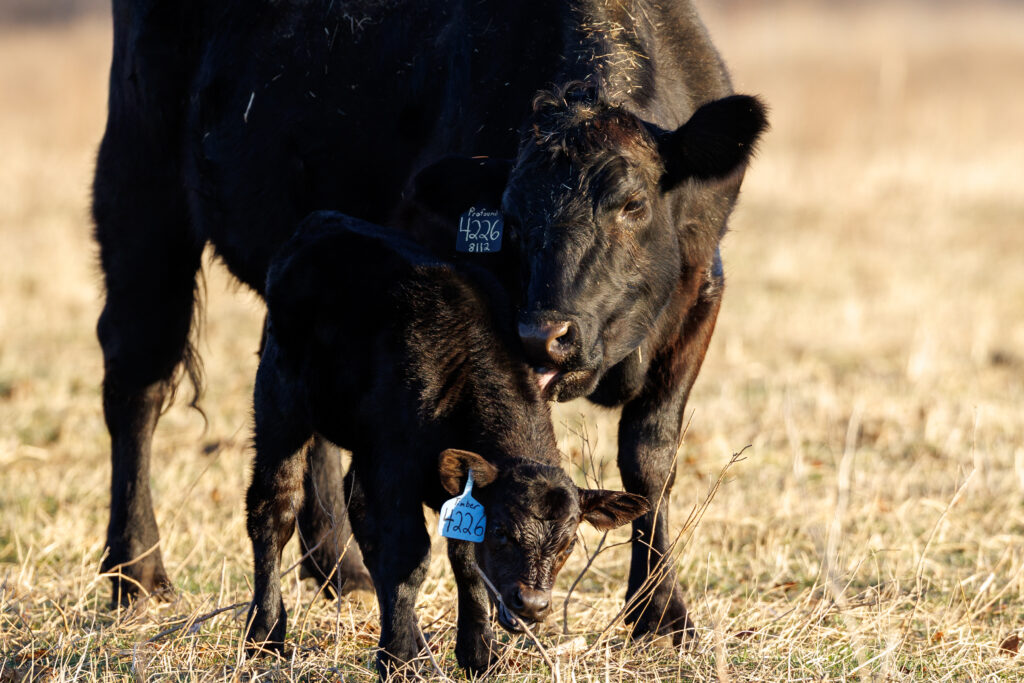
In beef cattle production, reproductive management of the cow herd plays a major role in determining herd productivity, health, and profitability. Understanding gestation length, selecting (and implementing) calving seasons, and managing reproductive health of the herd directly influences performance, calf crop health, and overall efficiency of the operation. Selecting the most appropriate calving season for your operation allows for the opportunity to match herd nutrient requirements to available forages and environmental conditions. Understanding gestation length aids in the selection of calving seasons by predicting calving dates. Utilizing both calving season and gestation management to your advantage is a great (and fairly easy) way to begin increasing profitability.
One of the most important management decisions in a cow/calf operation is determining when cows should calve. Yet, there is no single “best” calving season for every operation. The ideal system depends on forage resources, labor availability, weather patterns, marketing plans, and overall management goals. Regardless of whether producers choose spring calving, fall calving, or even a combination of both, having a defined and controlled calving season is one of the most effective ways to improve efficiency and profitability.
Research and standardized performance analysis (SPA) data collected from nearly 400 herds across Texas, Oklahoma, and New Mexico demonstrated that longer breeding seasons increased cost of production. In fact, each additional day in the breeding season increased cost per hundredweight of calf weaned. Herds that reduced breeding seasons from year-round to approximately 75 days substantially lowered production costs while also improving calf uniformity. Uniform groups of calves are generally worth more at sale time because buyers prefer cattle that are similar in age, size, and management background.
Controlled breeding and calving seasons also simplify management. Vaccination schedules, nutritional management, pregnancy diagnosis, weaning, and marketing can all be streamlined when cows calve within a relatively short window. In contrast, year-round calving often creates nutritional and labor challenges because cows are in different stages of production simultaneously.
Spring calving remains the most common system in Oklahoma and much of the Southern Plains. One advantage of spring calving is that cows are typically dry and pregnant during winter feeding. The dry, gestating period represents lower nutritional requirements compared to post-calving when cows are producing milk. Thus, wintering costs are generally lower for spring-calving cows. Calving too early (January and February) in Oklahoma may offset some of this advantage.
However, spring-calving systems are not without challenges. Severe late-winter and early-spring storms can result in newborn calf losses. Another disadvantage is that cows can slip in body condition during early spring forage green up. They tend to burn a lot of energy “chasing” bits of tender, green forage and may ignore the available, low-quality, standing forage or hay provided, resulting in inadequate forage intake and weight loss. This challenge is exacerbated when the early green up period coincides with peak lactation. Finally, delaying a spring calving season too long can expose females and herd sires to extreme late-summer heat stress during the breeding season.
Fall-calving systems offer a different set of advantages and disadvantages. Fall-calving cows are usually in excellent body condition at calving because they have recovered body reserves during summer grazing. Calves are also generally older and heavier at weaning. However, on most beef operations in Oklahoma, winter supplementation costs are greater in fall-calving cows. Increased nutrient requirements for lactation, in combination with lower quality winter forage or hay, results in a dramatic gap in nutrient supply. Without proper adjustments in the nutritional program, cows can experience rapid weight and body condition loss during the breeding season. In addition, if calving starts too early, extreme heat during late summer can lead to weak or even stillborn calves.
Heat stress deserves increasing attention in Oklahoma beef systems. Breeding cattle during periods of high heat and humidity can reduce conception rates, lengthen the postpartum interval, and negatively impact bull fertility. In some regions, pregnancy rates may decline substantially when cows are bred during late July through early September. Adjusting breeding and calving seasons to avoid predictable periods of extreme heat will most likely improve reproductive performance.
Regardless of calving season, management of cows’ body condition remains critical. Mature cows should generally calve in a body condition score (BCS) of approximately 5, while first-calf heifers should be closer to a BCS 6. Long-term data consistently shows that pregnancy rates decline dramatically in thin cows. Producers should evaluate whether their calving season aligns with forage availability and allows cows to maintain adequate body condition (while still being economically feasible). Also, recent research indicates that pregnancy rates to AI are improved when cows are slightly gaining weight and body condition during the breeding season. This is most economically achieved through timing of the calving season and selection for cattle that are a good match to the forage system.
There are also tradeoffs between operating one calving season versus two. A single calving season simplifies management and creates larger, more uniform groups of calves to market. Multiple calving seasons may spread marketing risk and increase bull utilization, but they also complicate labor, nutrition, and herd health programs.
When choosing a calving season, producers must also consider the length of gestation to schedule the proceeding breeding season. The topic of gestation length often comes up among cattle breeders during calving season. These conversations usually pertain to cows that have been bred by artificial insemination or embryo transfer, because exact breeding, implant, and expected calving dates are known. It is the observation of many that we have shortened the gestation length of modern beef cattle over the generations.
The gestational length of cows is commonly believed to be 283 days. However, gestation lengths can vary depending on several factors. For example, an article from the Journal of Animal Science in 1952 reported significant differences in the average gestation length of Angus (281.7 days), Hereford (286.1 days) and Shorthorn (284.3 days) breeds. Also, bull calves tended to be carried longer, and are heavier at birth, than heifer calves. This study also reported a significant positive relationship between birth weight and gestation length.
A 2024 abstract from the Journal of Animal Science analyzed a total of 10,037 records obtained from reproductive data collected from fall of 2011 through spring of 2018 from 14 herds across Virginia. Cows used to measure gestation length were all pregnant by artificial insemination (AI), and only pregnancies that resulted in a live birth were included in the data set. The objective of this study was to perform an analysis to determine gestational length and evaluate cow and calf parameters that influence gestational length of Bos Taurus beef cows. The average age of cows in this study was 5.5 years, with a minimum of 2 years and a maximum of 18 years of age. The average gestation length was 280.2 days. The shortest and longest gestation lengths recorded were 253 days and 300 days, respectively.
Gestation length was affected by calving season, with a slightly shorter gestation length in fall calvers (279.1 days) than spring calvers (281.1 days). Calf sex also had an impact on gestation length. Bull calves were gestated almost a day longer (280.8 days) than heifers (279.6 days). In conclusion, the average gestation length of Bos Taurus beef cows was 280 days, which is shorter than the commonly used 283 days, and it was affected by calving season (fall or spring) and calf sex. Further, while correlations exist between gestation length, cow age, and calf traits, these correlations were weak to moderate.
Ultimately, the “best” calving season is the one that best matches the operation’s environment and available resources. Producers should design systems that minimize purchased feed, maintain reproductive efficiency, and fit local forage resources. Careful consideration of these reproductive factors can help ensure a more productive and profitable beef cattle operation.

Emily Efrid is originally from Mount Ida, Arkansas, Emily earned her B.S. in Animal Science with a minor in Agribusiness from the University of Arkansas. She went on to obtain her M.S. in Animal Science with a special focus on beef cattle reproductive physiology from West Texas A&M University. Her research background includes studying effects of time of estrus, synchronization protocol, and sexed semen artificial insemination on pregnancy rates for beef cow/calf operations. She has served on the Arkansas Cattlemen’s Association State Board of Representatives and completed internships with the Arkansas Youth Expo, Arkansas Cattlemen’s Association, and National Cattlemen’s Beef Association. With a strong background in the beef industry, Emily is passionate about agriculture and is honored to serve as a resource for Okmulgee County cattle producers.