

If you want to find the most efficient workers on your ranch, you don’t look in the tractor cab or the saddle—you look under a fresh cow pat. While they aren’t the most glamorous part of the cattle business, dung beetles are currently one of the most effective tools we have for fighting high input costs and improving herd health in Okmulgee County.
As we navigate a 2026 season defined by high fertilizer prices and erratic weather, these “nature’s nutrient injectors” are providing services that would cost us thousands of dollars in mechanical labor and chemicals.
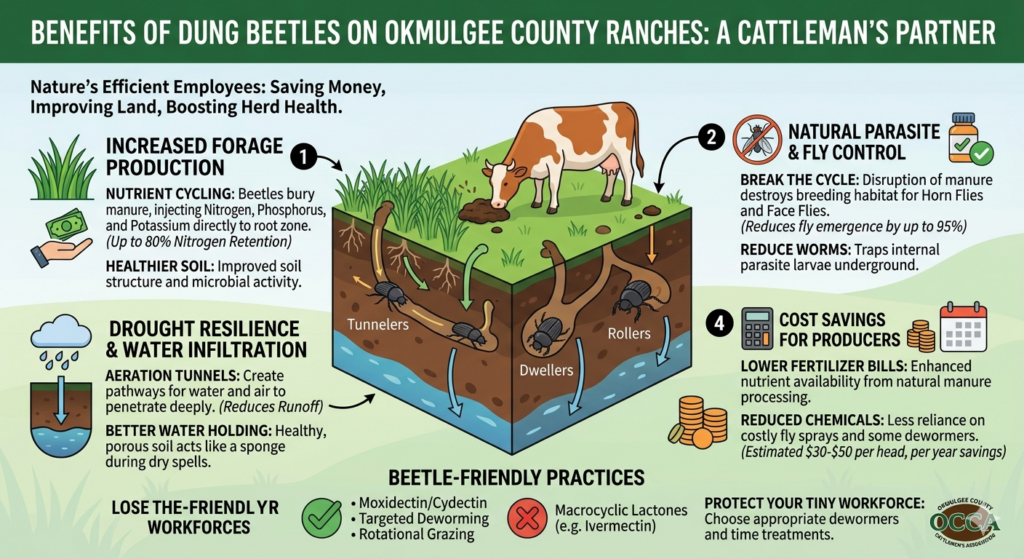
1. The “Free” Fertilizer Factory
A healthy population of tunneling dung beetles can bury a manure pat in as little as 24 to 48 hours. When they do this, they aren’t just cleaning the pasture; they are performing deep-soil nutrient injection.
- Nitrogen Retention: If manure sits on the surface, up to 80% of its nitrogen can evaporate into the air (volatilization). By burying it, beetles lock those nutrients into the root zone where your forage can actually use them.
- Yield Boost: Studies show that pastures with active beetle populations can see a 15% to 20% increase in forage growth. In a dry April like the one we’re seeing in Oklahoma, that extra grass is pure profit.
2. Breaking the Parasite Cycle
Dung beetles are the natural enemies of two of our biggest headaches: Horn flies and internal parasites.
- Fly Control: Horn flies and face flies lay their eggs in fresh manure. When beetles “shred” a pat to build their brood balls, they destroy the habitat the flies need. This can reduce fly emergence by up to 95%.
- Worm Management: Most internal parasites pass through the animal and wait in the manure for the right conditions to migrate onto the grass. By burying the manure, beetles trap the larvae underground where they die, effectively “cleaning” your grass for the next grazing rotation.
3. Drought Proofing Okmulgee Soil
In Okmulgee County, our clay-heavy soils can become impenetrable during a dry spell. Tunneling beetles act like tiny aeration machines. Their tunnels (which can go several feet deep) act as “micro-wells.” When we finally get those spring thunderstorms, the water follows the beetle tunnels down into the subsoil instead of running off into the creek.
How to Tell if Your “Employees” are Working
Take a walk through your pasture this week and look for these signs:
- The Holes: If you flip a pat and see dozens of small holes in the soil underneath, your “Tunnelers” are on the job.
- The Disappearing Act: In a healthy ecosystem, a manure pat should be 50% gone within a week. If you have “white” pats from last year still sitting on your grass, your beetle population is likely suppressed.
- The Shred: Look for pats that look like they’ve been put through a woodchipper. This is a sign of “Dwellers” actively competing with fly larvae for food.
Warning: Don’t “Fire” Your Workers
Many common dewormers and fly controls are inadvertently toxic to dung beetles.
- Beetle-Friendly Options: While most “avermectins” (like Ivermectin) are highly toxic to beetle larvae, products containing Moxidectin (Cydectin) have been shown to be significantly less harmful to these beneficial insects.
- Timing is Everything: Talk to our local OSU Extension office about a “Targeted Deworming” strategy. Treating only the cattle that need it—rather than the whole herd—allows your beetle population to thrive and do the work for you.
Bottom Line: A single dung beetle isn’t much to look at, but a healthy population can save a producer an estimated $30–$50 per head, per year. This spring, let’s make sure we’re managing our ranches to support the crew working beneath the grass.